Andrea Vennarucci portfolio header

Portfolio

Engineering Practice | Research Projects | Digital Innovation

A selection of projects connecting infrastructure engineering, road safety, virtual reality, digital twins, fire safety and data-driven methods.

This portfolio presents projects located at the intersection of civil engineering, transportation safety, digital technologies and public service. The aim is to show not only research outputs, but also the practical and technical path that connects infrastructure management, simulation, fire safety engineering and innovation.

The projects are organised as expandable cards. Each card provides a concise overview and can be opened to explore objectives, methods, technologies and outcomes.

Selected Projects

Click on each project card to open or close the detailed project sheet.

Driving Co-Simulation environment

Project overview

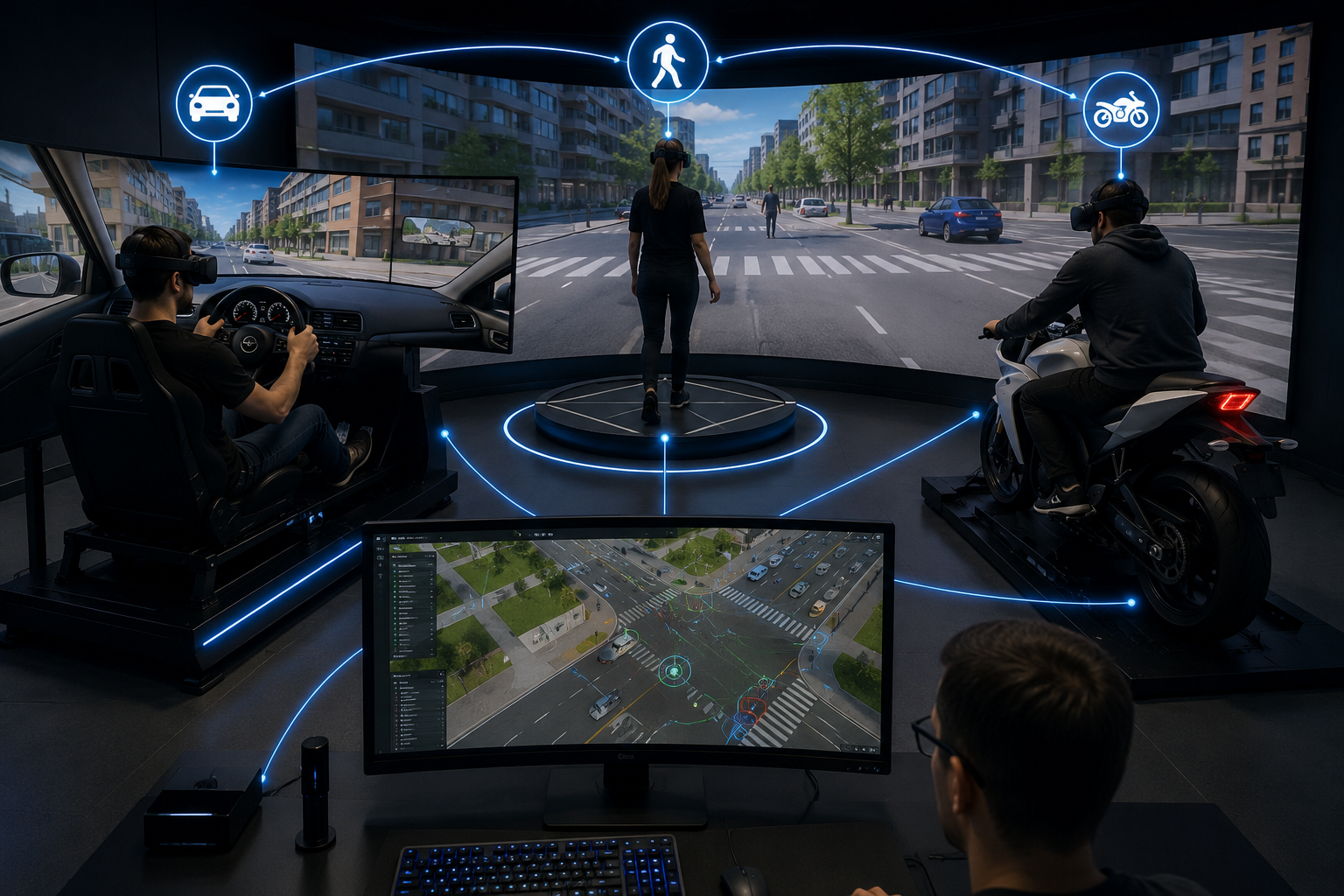
Development of a co-simulation architecture (Calvi et al., 2025) based on synchronized virtual environments in which multiple users and intelligent agents can interact simultaneously. This platform enables the study of complex mobility dynamics, mutual interference processes, and behavioural interactions between different categories of road users within immersive and high-fidelity simulation ecosystems. The system integrates virtual reality technologies, network synchronization, behavioural data acquisition, and real-time interaction modelling.

Main focus Road safety, driver behaviour, immersive simulation.
Role Scenario development, system integration, experimental setup.

Technologies

BIM Authoring Digital Twins Unity Virtual Reality Driving Simulation C# Human Factors Users Behaviour

Head-Mounted Display (HMD) Simulators

To establish a shared simulation environment, three highly immersive simulation platforms were developed. Together, they enable the investigation of the behaviour of different road users in both collaborative multi-user virtual environments and standalone simulation scenarios, providing a versatile framework for the study of human behaviour, traffic interactions and road safety.

HMD Driving Simulator

Development of a car driving simulation platform focused on the study of driver behaviour, human factors, and transportation safety. The simulator allows the recreation of controlled and repeatable experimental scenarios in which driving performance, decision-making processes, and interaction mechanisms between users, vehicles, and infrastructure systems can be analysed through immersive and data-driven methodologies.

HMD Motorcyclist Simualtor

Development of an immersive motorcycle riding simulator designed for the analysis of rider behaviour, risk perception, and interaction dynamics within complex traffic scenarios. The simulator integrates physical riding controls with virtual environments developed through advanced simulation technologies, enabling the investigation of behavioural responses under different road safety conditions, including interactions with vulnerable road users and critical traffic situations.

HMD Pedestrian Simulator

Development of an immersive pedestrian simulation platform aimed at analysing pedestrian behaviour, crossing decision-making processes, and interaction dynamics within urban traffic environments. The simulator enables the study of user perception, gap acceptance behaviour, and safety-related responses under controlled and repeatable experimental conditions. By integrating virtual reality technologies, behavioural data collection, and realistic traffic scenarios, the platform supports the investigation of interactions between pedestrians, vehicles, and surrounding infrastructure systems within highly immersive environments.
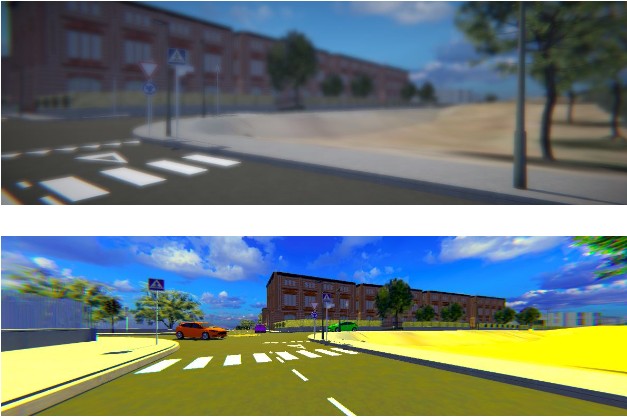
Working Proof of Concept

The complete proof of concept has been implemented and successfully tested. Current activities focus on validation, performance optimisation and consolidation of the BIM conversion workflow.

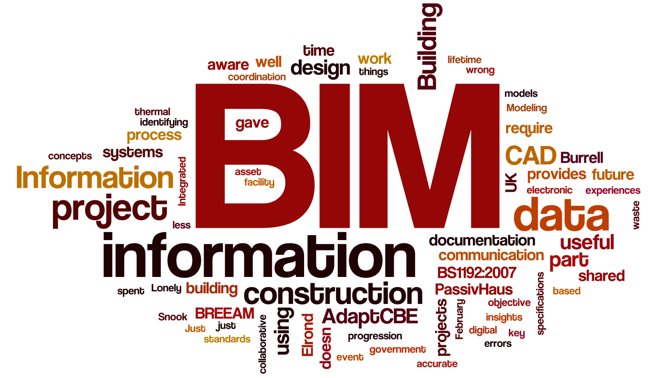
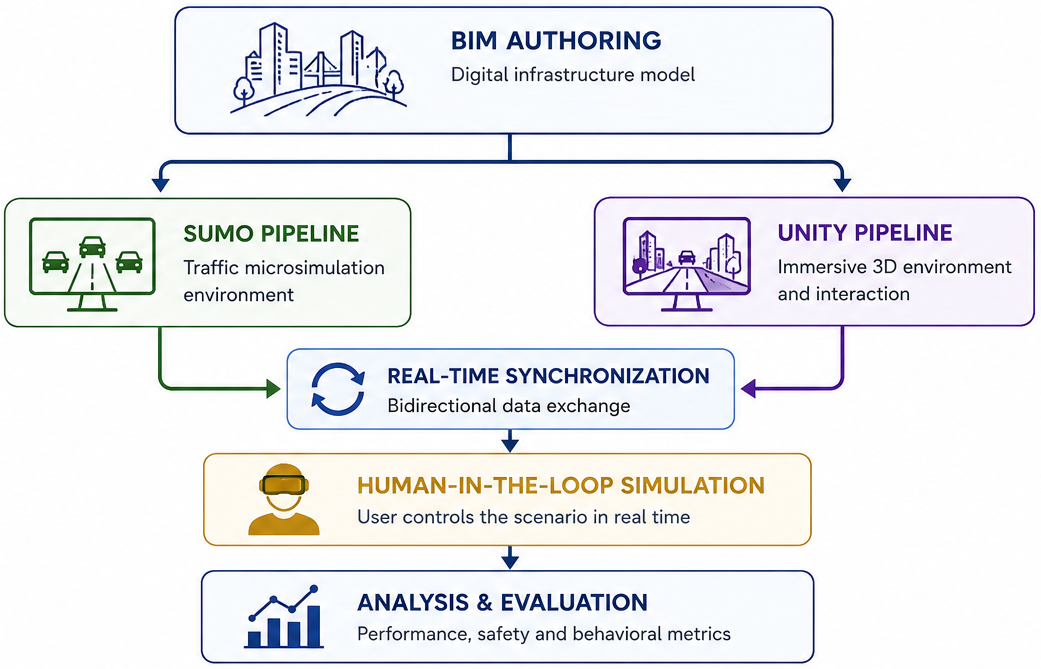
BIM SUMO Unity digital workflow

Project overview

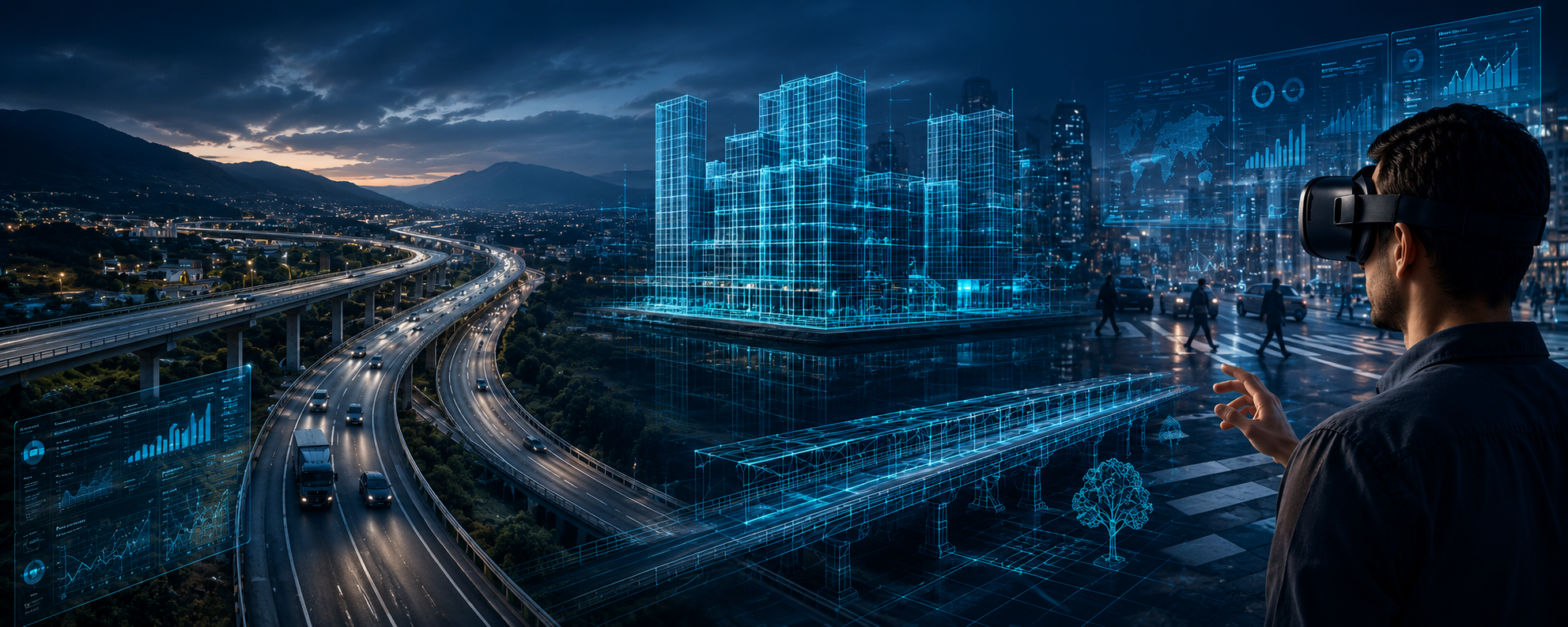
The project develops a common-source digital workflow connecting BIM-based road information, traffic microsimulation and immersive visualisation. The resulting environments support coordinated traffic representation and human-in-the-loop interaction within a shared simulation framework.

Main focus BIM interoperability, traffic microsimulation, immersive simulation and human-in-the-loop interaction.
Role Workflow conception, software integration and proof-of-concept development.

Technologies

BIM SUMO Unity Traffic Microsimulation Virtual Reality Human-in-the-Loop Digital Integration
BIM Conversion

A shared BIM-based source supports the preparation of coherent geometric environments for the different simulation platforms.

SUMO Network Generation

The road network is adapted for microscopic traffic simulation while maintaining compatibility with the original infrastructure representation.

Bidirectional Simulation

Traffic simulation and interactive visualisation are connected to support synchronized human-in-the-loop applications.

Driving Co-Simulation environment

Project overview

Research and development project focused on the design and implementation of an immersive Virtual Reality framework for the simulation of perceptual, cognitive and motor impairments induced by psychoactive substances. The project involved the analysis of scientific literature concerning alcohol, cannabis (THC) and hallucinogenic substances, the identification of reproducible behavioural and perceptual effects, and the development of modular simulation algorithms within a real-time 3D environment. The framework was designed to support education and awareness activities related to road safety, enabling the safe reproduction of altered states through Virtual Reality technologies and interactive simulation environments.

Main focus Road safety, driver behaviour, immersive simulation.
Role Scenario development, system integration, experimental setup.

Technologies

Unity Virtual Reality Driving Simulation C# Human Factors Users Behaviour

Key Outcomes

  • Development of a modular Virtual Reality framework capable of reproducing perceptual alterations associated with alcohol, THC and hallucinogenic substances.
  • Design and implementation of configurable visual, auditory and motor impairment simulation algorithms.
  • Integration of scientific evidence on psychoactive substance effects into immersive simulation environments.
  • Creation of a reusable software architecture applicable to road safety education and public awareness initiatives.

Digital twin project

Project overview

Research and development project concerning the implementation of Digital Twin methodologies for the management and valorisation of existing building assets. The work involved the creation of a structured digital information environment based on BIM principles, integrating geometric, technical and documentary information into a unified framework. The project addressed information acquisition, asset data modelling, digital documentation management and lifecycle-oriented asset management strategies, with the objective of enhancing operational efficiency, supporting maintenance activities and improving the overall accessibility and reliability of asset-related information.

Case Study

Palazzo Uffici di Ferservizi S.p.A., Gruppo Ferrovie dello Stato Italiane S.p.A.

Main focus BIM, digital twins, asset lifecycle, data integration, Property Management, Asset Management.
Role Digital modelling, asset analysis, information management.

Technologies

BIM Digital Twins Asset Management Facility Management Property Management Decision Support Due Diligence

Key Outcomes

  • Development of a Digital Twin framework for Asset Management applications.
  • Integration of BIM-based information models with operational Asset Management Processes.

Road safety research

Project overview

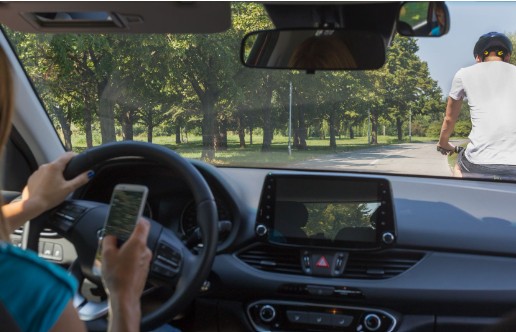
Research project focused on the analysis of driver distraction induced by smartphone use while driving. The study investigated the effects of texting activities on driver behaviour through an immersive driving simulation environment (Calvi et al., 2023). The research included a comprehensive literature review, a large-scale survey on driving habits involving more than 1,200 participants, the development of experimental driving scenarios, the implementation of controlled distraction conditions, and the statistical assessment of driving performance under conventional texting and smartphone-optimised interfaces (Calvi et al., 2024). The objective was to evaluate the impact of smartphone-related distractions on road safety and to assess the effectiveness of emerging driver-oriented technologies such as Android Auto in mitigating distraction-related risks.

Main focus Human behaviour, VRU safety, warning systems, risk assessment.
Role Research design, data analysis, scientific dissemination.

Technologies

Road Safety Human Factors VRU Interaction Statistical Analysis Simulator Studies

Key Outcomes

  • Development of an experimental methodology for assessing the effects of smartphone-induced distraction on driving performance.
  • Evaluation of behavioural and safety-related impacts associated with texting while driving.
  • Assessment of Android Auto as a driver support technology for reducing distraction-related effects.
  • Collection and analysis of behavioural data from immersive driving simulation experiments.
  • Identification of critical factors influencing driver attention, reaction capability and safety performance.

Engineering projects become meaningful when research, practice and technology converge toward safer and smarter systems.

Continue Exploring

Return to the top of the page or use the navigation menu to explore the remaining sections of the website.